

Approval of the bill for a Brazilian ETS in the Chamber of Deputies is a remarkable achievement


🌳 IN A REMARKABLE ACHIEVEMENT, THE BRAZILIAN CHAMBER OF DEPUTIES APPROVED A BILL TO ESTABLISH A NATIONAL ETS.


In a year marked by the worsening of the global climate crisis, in which we experienced extreme temperatures, droughts in unprecedented places and tragic floods, yesterday, Brazil experienced a historic moment within its Chamber of Deputies when the deputies approved a bill proposal to establish an emissions trading system (ETS) for the country. There were 299 votes in favor of the 404 parliamentarians present. This means that 73.76% of the deputies voted in favor of this major step for the decarbonization of its industries.

Since the sanction of the National Climate Change Policy in 2009, there has been a legal provision in Brazil for the creation of a regulated carbon market. It’s been a long 14 years of waiting, a period in which we missed great opportunities to position ourselves at the forefront of the world as a leading country in creating innovative solutions that drive economic growth in a sustainable manner. It’s worth remembering that, in 2009, the European ETS, the first regulated market of its kind in the world, was only 3 years old and was still in its infancy. Today it trades more than 754 billion Euros in its primary and secondary markets, generating € 42 billion annually of taxes for the bloc’s countries.


But why is having a regulated national carbon market so important for Brazil?


First, it is always important to highlight the differences between an ETS and the Voluntary Carbon Market. In an ETS, the State establishes a Greenhouse Gas (GHG) emission limit within the productive sector, enabling the eventual trading of deficits and surpluses of emissions between each other. On the other hand, the voluntary market is characterized by an environment in which people, companies and organizations neutralize their GHG emissions through purchases of carbon credits.

According to the proposed regulation, companies that emit more than 10 thousand tons of carbon dioxide equivalent – ​​CO2E1 per year will be required to establish a plan to monitor their emissions, developing a periodic report, while companies above 25 thousand tons of CO2E per year, in addition to reporting and monitoring, they will need to reconcile their emissions through emissions licenses distributed free of charge or at a cost by the government. It is estimated that there are around 5,000 companies in Brazil that emit more than 25 thousand tons of CO2E. Thus, the Brazilian Regulated Market, when implemented, will be the largest carbon market in Latin America.

Secondly, by creating an emissions license trading system, in which it is possible to transact emissions quotas between companies that have exceeded their respective GHG limits with companies that have managed to decarbonize their production processes, we enable carbon pricing to encourage the competitiveness of the Brazilian industry and its innovation.

As in Brazil more than 50% of greenhouse gas emissions are the result of deforestation, forest degradation and land use change, the proposed law is in the right way establishing interoperability between voluntary and regulated markets, through the possibility for companies to offset part of their emissions through the acquisition of Verified Emissions Reduction or Removal Certificates – CRVE, which will be voluntary carbon credits converted for commercialization in the regulated market, after the definition, by the Brazilian State, of which certification bodies and methodologies currently available will be capable of acceptance in this new market.


Other advances in the Brazilian voluntary carbon market in the proposal approved by the Chamber of Deputies:


  • Legal certainty on points such as the ownership of credits, in which it was defined that, while the current status for voluntary carbon credit remains, when a carbon credit is transformed into a CRVE, it will be interpreted as a “market asset”)
  • Free initiative (including at a state level) in the development of carbon projects
  • Rules that prevent double counting of credits and increase the socio-environmental integrity of projects
  • Update of tax legislation regarding credits
  • Freedom for states to implement their own jurisdictional programs (under the responsibility of the public authorities) for carbon generation, while at the same time there is also the guarantee of the possibility for private properties to exercise their property rights by requesting the exclusion of their respective areas from such programs
  • Environmentally appropriate waste disposal and recycling projects can generate carbon credits
  • Guaranteeing appropriate benefit sharing for traditional communities and indigenous peoples, in which ARR initiatives will allocate to those communities at least 40% of the carbon credits generated, while REDD+ projects will allocate a minimum of 60%
  • Guarantee that those settled in agrarian reform projects have the same rights and duties as indigenous peoples and traditional communities


New additions to the emissions trading system included:


  • An allocation of 85% of the resources raised by the regulated market to finance scientific research and technological development activities with the aim of promoting the decarbonization of productive activities
  • Entry of motor vehicles as a source of regulated emissions
  • Environmentally appropriate waste treatment and final disposal units will be considered based on their transversal potential for mitigating greenhouse gas emissions and will not be subject to the emission limits set out in the law when they are proven to adopt systems and technologies to neutralize such emissions.
  • Double appeal level for possible application of fines for non-compliance with emissions reconciliation.


Lastly, it is important to note that there are still several steps necessary to implement a Brazilian ETS. The proposal will now be sent back to the Federal Senate, which has already approved material that was used as the basis for the bill approved by the Chamber of Deputies. This should speed up the legislative process, but as highlighted, the bill has suffered several modifications that need to be discussed. Finally, if the bill is sanctioned, the proposed timeline of implementation is five years.

Biofílica Ambipar Environment will continue to share our technical expertise with the Brazilian parliament, the Federal government, civil society and, principally, our clients, to engage in their business decarbonization.


[1] CO2E is a metric measure used to compare emissions of various greenhouse gases based on global warming potential relative to carbon dioxide (CO2). For example, the global warming potential of methane gas is 21 times greater than the potential of carbon dioxide (CO2). So, we say that the CO2 equivalent of methane is equal to 21.

COP28 and the Voluntary Carbon Market


At COP28 in Dubai, the main entities and stakeholders of the voluntary Carbon Market (VCM) have joined forces to improve integrity, trust and scale, reflecting a very positive perspective regarding the future of this climate financing mechanism.

On the supply side, it has been announced that several stardards are going to work together in order to adhere their methodologies to the Core Carbon Principles (CCPs), a set of parameters defined by the Integrity Council for the Voluntary Carbon Market – ICVCM to qualify carbon credits as of high quality and integrity.

On the other hand, some of the most important entities alongside the demand for carbon credits like Science Based Targets Iniciative – SBTi, the Voluntary Carbon Markets Iniciative – VCMI, GHG Protocol and We Mean Business Coalition came together to develop an end-to-end, science based integration in the decarbonization guidance that will help companies to decarbonize their production processes and use carbon credits to offset their residual emissions.

The urgency of climate action is evident and VCM is one of the most cost-effective tools to accelerate global decarbonization. Below we present you a summary of the main announcements at this COP:


VCMI, SBTi, ICVCM, WMB and GHG Protocol come together to promote VCM as climate action tool

In a historic announcement and with the support of the COP28 board, the Science Based Targets Initiative – SBTi, the Voluntary Carbon Markets Initiative – VCMI, the Integrity Council for the Voluntary Market – ICVCM, GHG Protocol and the We Mean Business Coalition – WMB informed that they will join forces to establish an integrity guidance that provides scientifically based methodologies for the decarbonization of production processes and the use of voluntary carbon credits to offset residual carbon emissions.


World’s biggest stardards announce colaboration to increase the positive impact of Carbon Markets

Verra, American Carbon Registry – ACR, Architecture for REDD+ Transactions – ART, Climate Action Reserve, Global Carbon Council and Gold Standard announced that they will work together to create common principles related to the quantification, verification and permanence of reductions and removals of carbon emissions in their respective methodologies. The partnership aims to ensure that the methodologies of each of these certifiers adhere to the Core Carbon Principles – CCPs – a set of parameters developed by the Integrity Council for the Voluntary Carbon Market – ICVMC, to identify high-integrity voluntary carbon credits.


CFTC issues proposed guidance regarding the listing of Voluntary Carbon Credit Derivative Contracts 

The Commodity Futures Trading Commission – CFTC has approved a proposed guidance and request for public comment regarding the listing for trading of voluntary carbon credit derivative contracts. The proposal outlines certain factors a CFTC-regulated exchange, or designated contract market, should consider when addressing requirements of the Commodity Exchange Act (CEA) and CFTC regulations that are relevant to the contract design and listing process.


European Commission President speeches about VMC’s importance

The president of the European Commission, Ursula von der Leyen, spoke about the urgency of developing new carbon markets that adhere to the Paris Agreement, with the aim of combating climate change. In her speech, she highlighted the need for the world to advance in three objectives: helping more and more countries to create their own regulated carbon markets and that these markets really have the ambition to promote the reduction of emissions and. Furthermore, the importance of encouraging private capital to finance the voluntary carbon market, with a view to enabling the continuity of projects that protect biodiversity.


World Bank Carbon Credits to Boost International Carbon Markets

World Bank Engagement Road map for High-Integrity Carbon Markets seeks to expand transparent and inclusive carbon markets that will help developing countries in Africa, Latin America and Southeast Asia to protect their forests.


Iosco proposes suite of good practices for VCM

The International Organization of Securities Commissions – Iosco, requested public comment regarding a manual of good practices to promote the integrity of the VCM. The document seeks to provide legal support to jurisdictions that have established or may be seeking to establish national regulations for their respective voluntary carbon markets.


UN Climate Change Executive Secretary speech at voluntary carbon market roundtable

UNFCCC Executive Secretary Simon Stiell stated that there is an urgent need for countries to accelerate efforts to combat climate change and decarbonize their economies. In this sense, carbon markets are one of the viable tools that can be implemented now and at scale. To achieve this, it is necessary to strengthen the credibility, integrity and transparency of voluntary credits.


Climate Impact X launches new trusted carbon credits contracts

Climate Impact X, a global marketplace for trusted carbon credits announced that it is going to launch a suite of new trading venues in order to negociate carbon credits contracts adherent to the Core Carbon Principles (CCPs).


United States and Partners Announce Energy Transition Accelerator Framework

The U.S. Department of State, the Bezos Earth Fund, and The Rockefeller Foundation presented the core framework of the Energy Transition Accelerator (ETA), an innovative carbon finance platform aimed at catalyzing private capital to support ambitious just energy transition strategies in developing and emerging economies.


UNDP launches plan to boost integrity in carbon markets and increase access to finance schemes

The United Nations Development Programme (UNDP) today launched a new initiative at COP28 to support developing countries’ access to carbon markets, mitigate social and environmental risks and promote accurate carbon accounting.


Brazilian Development Bank announces new program to restore the Amazon Forrest

The National Bank for Economic and Social Development (BNDES) announced the Arco da Restauração Program, which aims to invest more than US$ 200 million in the restoration and reforestation of 60 thousand square kilometers of the Amazon Forest by 2030.


Seven UE countries propose framework to prevent greenwashing and boost integrity in voluntary carbon markets

The Netherlands, Germany, France, Spain, Finland, Belgium and Austria proposed a framework aiming at preventing greenwashing complaints against companies. Among the proposals, is the recognition of the use of carbon credits for companies’ climate action.


Institute for Global Environmental Strategies works to advance engagement in international carbon markets

The Global Institute for Environmental Strategies (IGES), through the Partnership for the Implementation of Article 6 of the Paris Agreement, announced that it will partner with the International Emissions Trading Association (IETA), aiming to implement and enhance the market mechanisms stipulated in Article 6 of the Paris Agreement.


IETA organizes webinar exploring key developments and 2023 outlooks across Latin America and the Caribbean (LAC)’s expanding carbon market landscape.

The event will take place on March 16 and will be online. Companies, organizations, and government members from Latin American countries will participate.


The International Emissions Trading Association (IETA) is a non-profit business association created to establish trading and policy guidelines for the carbon markets and to be the central voice for market-based climate solutions.

In order to foster and stimulate exchange on the subject, the association is organizing the webinar IETA LIVE – Latin America Carbon Markets Roundup: Updates and Outlooks for 2023. During the webinar, IETA members, government representatives and carbon market experts from Latin America will share valuable information about the current state of the voluntary markets and their prospects for 2023.

Biofílica Ambipar, the 1st Brazilian developer of forest carbon projects to join IETA, will participate in the event represented by Annie Groth, Head of Advocacy & Policy, who will talk about the perspectives of the Brazilian market given the current political situation in comparison with other Latin American countries.


“We were flattered by the invitation and excited to share our vision and hear from others their impressions and expectations for this year. It will certainly be an enriching exchange.” – comments Annie.


THE EVENT WILL BE ONLINE AND REGISTRATION IS OPEN.


IETA reinforces that as the world moves towards a low-carbon future, the voluntary carbon market plays an increasingly vital role in driving sustainable development.

The event is an opportunity to stay ahead of the curve and gain a deeper understanding of the rapidly evolving, innovative market landscape in Latin America.

🌿 Empowerment Part 2: Course on Botanical Identification and Monitoring at the RESEX Jacundá

Residents of the Rio Preto-Jacundá Extractive Reserve are already applying the knowledge acquired during the Botanical Identification Course to improve flora monitoring and support low-impact forest management.

Botanical Identification Course at the Rio Preto-Jacundá Extractive Reserve

As presented in our previous article about the Botanical Identification Course, the initiative was designed to strengthen the technical capacity of members of ASMOREX (Association of Residents of the Rio Preto-Jacundá Extractive Reserve), where the RESEX Jacundá REDD+ Project is developed.

Created in response to the needs identified by community members engaged in sustainable forest management, the course is already generating practical results. Participants have begun applying the techniques learned to identify native plant species, monitor biodiversity and support forest conservation activities throughout the Reserve.


“This course is extremely important, especially for our community. Those of us working with forest management and restoration often face challenges in botanical identification because of the enormous biodiversity found here. For me, as a graduate student, the greatest value is learning how to correctly identify species and generate reliable data that represent the Western Amazon, which is the focus of my research.”

Ariane Cristina, Forest Engineer

According to Erisson Medeiros, collaborator at the New York Botanical Garden, the main objective of the course was to provide participants with the skills required to collect botanical samples, identify species correctly and, whenever necessary, access technical networks capable of confirming species identification with scientific accuracy.

“Before, we identified trees mainly by their bark. Now we can also recognize them through their flowers and leaves. This knowledge will make a real difference because I recently started working with botany, and this course has given me much more confidence.”

Ludbre de Oliveira, ASMOREX resident


Watch the participants’ testimonials

Hear directly from community members and project partners about how the Botanical Identification Course is strengthening local capacity for biodiversity monitoring and sustainable forest management.


Knowledge that strengthens forest conservation

The RESEX Jacundá REDD+ Project is the first REDD+ initiative developed within a state conservation unit in Rondônia and remains the only project of its kind operating under both Verra VCS and Climate, Community & Biodiversity Standards (CCBS) certification.

Developed through a partnership between Biofílica and ASMOREX, the project demonstrates how forest conservation can be combined with community development. Alongside REDD+ activities, residents practice low-impact forest management while generating income through sustainable forest products and environmental services.

Initiatives such as the Botanical Identification Course reinforce this long-term strategy by providing practical knowledge that enables residents to monitor biodiversity more effectively, improve forest management practices and reduce pressure on native vegetation. When communities have opportunities to prosper while remaining in the forest, conservation becomes an integral part of local development.

Biofílica also acknowledges the collaboration of all organizations that contributed to making this initiative possible, including ASMOREX, CES Rioterra, UNIR (Federal University of Rondônia) and the New York Botanical Garden.


Discover how the RESEX Jacundá REDD+ Project combines forest conservation, biodiversity monitoring and community development while generating high-integrity carbon credits.


Learn more about the RESEX Jacundá REDD+ Project

Empowerment: residents of RESEX Rio Preto-Jacundá have a Botanical Identification Course – Part 1

Reducing deforestation, protecting biodiversity and expanding access to education are key pillars of the Rio Preto-Jacundá REDD+ Project. Residents engaged in sustainable forest management received specialized training in botanical collection and species identification.

Botanical Identification Course at the Rio Preto-Jacundá Extractive Reserve

Continuous community engagement in forest conservation activities encourages residents to better understand the value of the Amazon and motivates them to improve the skills needed for sustainable forest management. Supporting education and technical training is therefore one of the core commitments of the Rio Preto-Jacundá REDD+ Project.

Based on needs identified by the residents themselves, the Botanical Identification Course was included in the project’s 2022 Activity Plan. The initiative was developed through a partnership between Biofílica, ASMOREX, CES Rioterra, UNIR (Federal University of Rondônia) and the New York Botanical Garden, providing practical training on the identification of native tree species through leaves, fruits and seeds.


“This week we are participating in the Botanical Collection and Identification Course, where we are learning about every part of a tree—its leaves, fruits and seeds. It has been a very promising activity, and we have learned a great deal.”

Denise Viana, President of ASMOREX

Beyond technical instruction, the course aims to strengthen local capacity so that community members can improve their livelihoods while contributing to scientific knowledge and sustainable forest management. Residents who live and work in the forest become essential partners in collecting botanical information, identifying species and supporting restoration and conservation initiatives.

“Without knowing the native plant species, it is impossible to manage forests or restore degraded areas. We need to train the people who live in the forest so they become our partners in identifying, collecting and understanding the local flora.”

Flávio Obermuller, Biologist at the New York Botanical Garden


Community empowerment supports conservation and sustainable development

The Rio Preto-Jacundá REDD+ Project recognizes that empowering local communities is fundamental to achieving long-term conservation outcomes. Educational initiatives such as this course directly contribute to two of the project’s primary objectives:

  1. Promote the reduction of deforestation, conserve standing forests and protect biodiversity while maintaining ecosystem services and preserving the traditional livelihoods of families living in the Extractive Reserve.
  2. Expand access to quality education and technical training, creating opportunities for better employment conditions, income diversification and sustainable economic development.

These initiatives contribute directly to the United Nations Sustainable Development Goals (SDGs 4 – Quality Education and 15 – Life on Land) while strengthening the social and environmental performance required to maintain the project’s CCBS Gold Level certification.


Watch the participants’ testimonials

Learn how the Botanical Identification Course is helping strengthen sustainable forest management and biodiversity conservation through the voices of the people directly involved.


Learn more about the Rio Preto-Jacundá REDD+ Project and discover how your organization can support forest conservation while offsetting carbon emissions with high-integrity carbon credits.


Learn more about the Rio Preto-Jacundá REDD+ Project

RESEX Jacundá REDD+ Project: community receives a visit from a pediatrician.

For the first time, children living in the Rio Preto-Jacundá Extractive Reserve received specialized pediatric care. The initiative was identified by community leaders and incorporated into the annual action plan of the RESEX Jacundá REDD+ Project.

Pediatric care provided to children in the Rio Preto-Jacundá Extractive Reserve

Although financing vulnerable communities became a major topic during COP27, supporting local development has been a fundamental component of the RESEX Jacundá REDD+ Project since its inception. The project recognizes that improving quality of life is directly connected to long-term forest conservation and the reduction of deforestation.

Operating within the Rio Preto-Jacundá Extractive Reserve, the initiative seeks to strengthen traditional extractive livelihoods, support community organizations and reduce rural migration by creating better living conditions for local families. Through its Community Life Plan, the project promotes actions focused on health, education and social development based on priorities identified by the residents themselves.

In 2022, community leaders from ASMOREX identified the need to provide specialized pediatric care due to the growing number of young children living in the Reserve. As a result, pediatric consultations were included in the project’s annual action plan, leading to the first-ever visit of Dr. Helena, who provided medical care for children from birth to five years of age.


“This is an unprecedented initiative in the Reserve. We included it in our annual planning, and today Dr. Helena is here providing pediatric care for the children of our community.”

José Pinheiro Borges, Community Leader of ASMOREX

The primary objective of the initiative was to begin monitoring children’s development from early childhood by assessing growth, identifying potential health conditions at an early stage and referring patients to specialized medical services whenever necessary. Early diagnosis and preventive healthcare are essential for improving quality of life and ensuring healthier childhood development in remote Amazon communities.


Watch how the initiative benefited the community

Learn more about this unprecedented healthcare initiative through the testimonials of community members and project partners.


Health and conservation go hand in hand

The pediatric consultations represent another example of how the RESEX Jacundá REDD+ Project integrates social development with environmental conservation. By investing in healthcare, education and community well-being, the project strengthens local resilience while creating the conditions necessary for families to continue living sustainably within the forest.

Initiatives driven by community priorities reinforce the project’s long-term commitment to improving quality of life and demonstrate how climate finance can generate lasting social benefits alongside biodiversity conservation and deforestation reduction.


Learn more about the RESEX Jacundá REDD+ Project and discover how your organization can support community development while offsetting carbon emissions through high-integrity carbon credits.


Learn more about the RESEX Jacundá REDD+ Project

Ambipar Wins 5th EF Awards for Corridors for Life ARR Project

Ambipar receives for the 5th time an Environmental Finance Award for its Corridors for Life AR Project in partnership with IPÊ.

For the first time, Ambipar is awarded the prize for “Best Individual Offsetting Project”

São Paulo, September 26th, 2022 – Ambipar won an Environmental Finance Award for the fifth time. In this edition, the company was awarded for the first time in the category “Best Individual Offsetting Project” for its Corridors for Life AR Project, developed in partnership with IPÊ (the Institute for Ecological Research), a Brazilian socio-environmental organization that has developed projects since 1992 for the conservation of the Atlantic Forest. In the four previous editions, Ambipar received awards in the “Best Project Developer, Forest and Land use” category in 2015, 2018, 2019 and 2020. This year, it came in second place.

The winning project is part of a new phase of the Corridors for Life Project, created and implemented by IPÊ in 2002 in the Pontal do Paranapanema, extreme west of the state of São Paulo, in the Atlantic Forest biome. IPÊ’s work is an initiative supported by three pillars: climate, community and biodiversity, with national and international recognition. This forest restoration work has as its starting point the “Dream Map of Pontal do Paranapanema,” created through IPÊ’s expertise, which defined the priority areas for reforestation in western São Paulo in seven municipalities.

“It is with great joy that we once again receive the Environmental Finance Award. We have won four other awards, and this time we won with one of our important projects, the Corridors for Life AR Project. In this case, besides the climate and biodiversity component, this project promotes several benefits to the community, mainly through environmental education activities, from the implementation of courses and incentives to the establishment of forest seedlings nurseries, which makes us very proud of the work we have done together with our partners”, celebrates Plínio Ribeiro, Board Member of Ambipar.

“We are very happy with the award dedicated to the project. The partnership with Ambipar is very relevant for us to scale up our carbon mitigation and socioenvironmental impact in the Pontal do Paranapanema. This year alone, forest restoration has guaranteed 250 jobs in the region. Many people find in this activity a chance to generate income for their families – from those who work in IPÊ’s nurseries to the companies that execute the plantations accompanied by our technical team. An award is always a great recognition, but also a great responsibility to do more and better for the Atlantic Forest and Brazilian biodiversity, which is IPÊ’s mission”, says Dr. Laury Cullen Jr, coordinator of the Corridors for Life Project at IPÊ.


The partnership with Ambipar from 2021 onwards

In 2021, IPÊ expanded its reforestation actions through a partnership with Ambipar, creating together the Corridors for Life AR Project and directing efforts towards the generation of carbon credits to be certified by the Verified Carbon Standard (VCS) and Climate, Community and Biodiversity (CCB) standard, of Verra. By restoring the Atlantic Forest in the Pontal do Paranapanema region through the planting of seedlings, enrichment, or regeneration of areas, the project contributes to the conversion of 75,000 hectares of areas of environmental liabilities on private properties into restored areas with about 150 million new tree seedlings.

With the adhesion of the carbon component, the priority areas of the “Dream Map” were expanded from 7 to 30 municipalities. The Corridors for Life AR Project has already restored 500 hectares since December 2021, which is equivalent to approximately 1 million Atlantic Forest tree seedlings, and will implement another 1,250 hectares by the end of 2023, totaling 1,750 hectares in two years of operation. The expectation is to attract companies interested in buying the carbon removal credits.

Dr. Laury Cullen highlights: “The forest restoration work that IPÊ carries out together with partners has the CCB – Climate, Community and Biodiversity – as a tripod. I emphasize that in the Climate sphere, forests remove carbon, which contributes to mitigate the effects of climate change. Regarding Community, the generation of employment is notable in local communities, generating an increase in income. As for Biodiversity, forest restoration and landscape management contribute to the conservation of flora and fauna, and thus to the entire biodiversity”. The black lion tamarin (Leontopithecus chrysopygus), an endangered species and the focus of IPÊ’s project, is also among the species benefited by the restoration actions.


About Ambipar Carbon Solutions

Founded in 2008, Ambipar’s mission is to be the world’s leading company in Nature-Based Solutions (NbS). Since 2021, we have been part of Ambipar, within the Carbon Solutions business unit.

Our goal is to create value in the environmental assets market, combat climate change, protect biodiversity, and promote social well-being and development.

We believe that Nature-Based Solutions are essential for humanity to meet the goals of the Paris Agreement and overcome the climate crisis. It is estimated that by 2030, between 35% and 50% of emission reductions should come exclusively from these solutions.

We develop projects that promote emission reductions through forest conservation, in addition to capturing carbon through reforestation.


About IPÊ

IPÊ – Ecological Research Institute – is a Brazilian non-profit organization that works for the conservation of biodiversity in the country through science, education and sustainable business. Founded in 1992, it has its headquarters in Nazaré Paulista (São Paulo), where its education center, ESCAS – Escola Superior de Conservação Ambiental e Sustentabilidade, is also located.

Present in the Atlantic Forest, Amazon, Pantanal and Cerrado biomes, the Institute carries out around 30 projects a year, applying the IPÊ Conservation Model, which involves scientific research on species, environmental education, community involvement and mobilization, habitat and landscape conservation, and support for the construction of public policies. In addition to local projects, the Institute also implements work in several regions, following the themes Protected Areas, Urban Areas and Research & Development (Natural Capital and Biodiversity).

www.ipe.org.br


About Ambipar

With its administrative office in São Paulo and head office in Nova Odessa – SP, Ambipar is a Brazilian multinational with a presence in 16 countries in South America, Europe, Africa, North America and Antarctica. Formed by Ambipar Environment and Ambipar Response, two segments of reference in the environmental management market, it has in its DNA the commitment to sustainable issues, working the ESG Pillars within its business and supporting its clients.


Biofílica is now Ambipar Environment

Dear all,

It is with great enthusiasm that I share that Biofílica is now Ambipar Environment, after being acquired by the Ambipar Group, which operates in several segments offering complete products and services focused on environmental management.


The deal concluded this week aims to accelerate our growth, enhancing our synergy with Ambipar and expanding the group’s portfolio of environmental services. The expansion plan for the coming months foresees massive investment in the development of Nature-Based Solutions (NBS) carbon projects and programs, and in the medium term, our mission is to become the world’s largest NBS company.

For Ambipar, the acquisition increases its portfolio as it begins to act with conservation projects in the Amazon, reforestation and restoration, sustainable agricultural management and legal reserve compensation, incorporates the know-how on greenhouse gas (GHG) management strategies much demanded by current customers, expands its national and international regulatory knowledge on climate change and carbon markets, and reinforces the environmental and social pillars of its ESG.

I will continue to lead the business, as well as our entire team, which will be expanded, and I will follow up on the projects and activities that are in progress and will continue to search for innovations and improvements to serve our customers and partners.


NEW SOLUTIONS


We have recently incorporated into our portfolio two more solutions that meet the demand for emission offset through carbon credits: Agricultural Land Management (ALM) — an approach in which farmers adopt innovative technologies and improved management practices that improve the quality and storage of carbon in the soil, thus, intensifying agricultural production while generating carbon credits; and Afforestation/Reforestation (AR) — an approach based on carbon storage in biomass by planting new trees in areas where there was no forest (afforestation) and in areas where there was deforestation (reforestation), recovering the natural ecosystem.

Pioneers in the national market of environmental services, our intention is to always follow the evolution of this market, adding new approaches. Among them, Blue Carbon — an approach that generates carbon credits through the conservation and restoration of coastal and marine ecosystems.


GROWTH PLAN

The resources of this transaction will be invested in the development of the Biofílica Platform, which will use state-of-the-art technology to originate credits in agriculture and the commercialization of environmental services, and also in the development of large REDD+ and Forest Restoration projects, with the aim of making us the largest company focused on Nature Based Solutions in the world.

Our focus, dedication, intelligence and loyalty to our customers and partners does not change. We will be even better prepared to offer solutions to companies, governments and individuals who want to neutralize carbon emissions from their activities that could not be avoided, in addition to promoting the generation of positive impacts on climate, society and biodiversity.


Warm wishes,

Plínio Ribeiro
Co-founder & CEO
Biofílica Ambipar Environment


Nature-based solutions: these initiatives are effective solutions to fight the climate change – Part 1

The natural forms of counteracting climate changes are the most efficient ones. For such a reason, investing in nature-based solutions is a key mechanism to meet targets of reduction of emissions of the Paris Agreement.

Nature-based solutions (NBS) is a concept defined by the International Union for Conservation of Nature (IUCN) such as actions to protect, manage, and restore natural ecosystems in a sustainable and effective way, taking into account the complexities and well-being of human and biological diversity. Within the concept, practices of intelligent management of lands to reduce or remove the emissions of greenhouse gas (GHG) are also conducted.

2020 has been marked as a game-changer for the construction of a more sustainable future with the Paris Agreement entering into force. We see the consciousness and mobilization for the need for even greater changes – a fact that is reaffirmed with the increase in the search of the governors and leaders of great corporations for supporting and enabling the NBS.

In fact, the effectiveness of natural solutions for fighting against climate change is huge. A study conducted by Proceedings of the National Academy of Sciences of the United States of America (PNAS) has shown that such solutions may be responsible for fulfilling more than one-third of the climate change mitigations necessary to achieve the goal of stabilizing global warming in up to 2°C until 2030.


Conserving forests is paramount for a sustainable future

Building a healthy future means provisioning the needs of the current generation without compromising the resources of future generations. For this to be possible, we must act today to reverse the climate change effects – which are mostly caused due to the excess greenhouse gas (GHG) emissions in the atmosphere.


The standing forests, in addition to conserving the biodiversity, have an incomparable capacity of absorption and storage of carbon, and, opposite to what is usually thought, keeping them does not adversely influence the capacity of agriculture and cattle raising production, mainly in Brazil, where there are many already open areas that could be used for the smart and low-carbon cultivation.

However, this is a job that goes beyond environmental backgrounds. Therefore social and environmental matters are also considered when classifying a mechanism such as NBS. For deforestation to be avoided, investments that remunerate ecosystem goods and values are necessary, so that keeping the forest is more advantageous than deforesting it.


REDD+: one of the most complete nature-based solutions

REDD+ is an innovative and collaborative mechanism developed to actively contribute to the fight against climate change and in favor of the decrease of global warming through the conservation of native forests.


As of internationally known methodologies and by means of social, economic, and environmental activities, it is possible to remunerate those who maintain the forests standing. Therefore, it is possible to generate carbon credits, considering that once they are traded, they generate financial resources for the conservation economy.

Due to all its complexity and the set of actions that are part of REDD+, the mechanism fits in as a nature-based solution that is accessible and effective to address corporate emissions neutralization demands.

Understand better what it is and its positive impact in our article: After all, what is REDD+


Your company may contribute to preserving biodiversity, fighting against climate change, and supporting the Amazon Rainforest’s socio-economic development while it neutralizes emissions through the carbon credits.


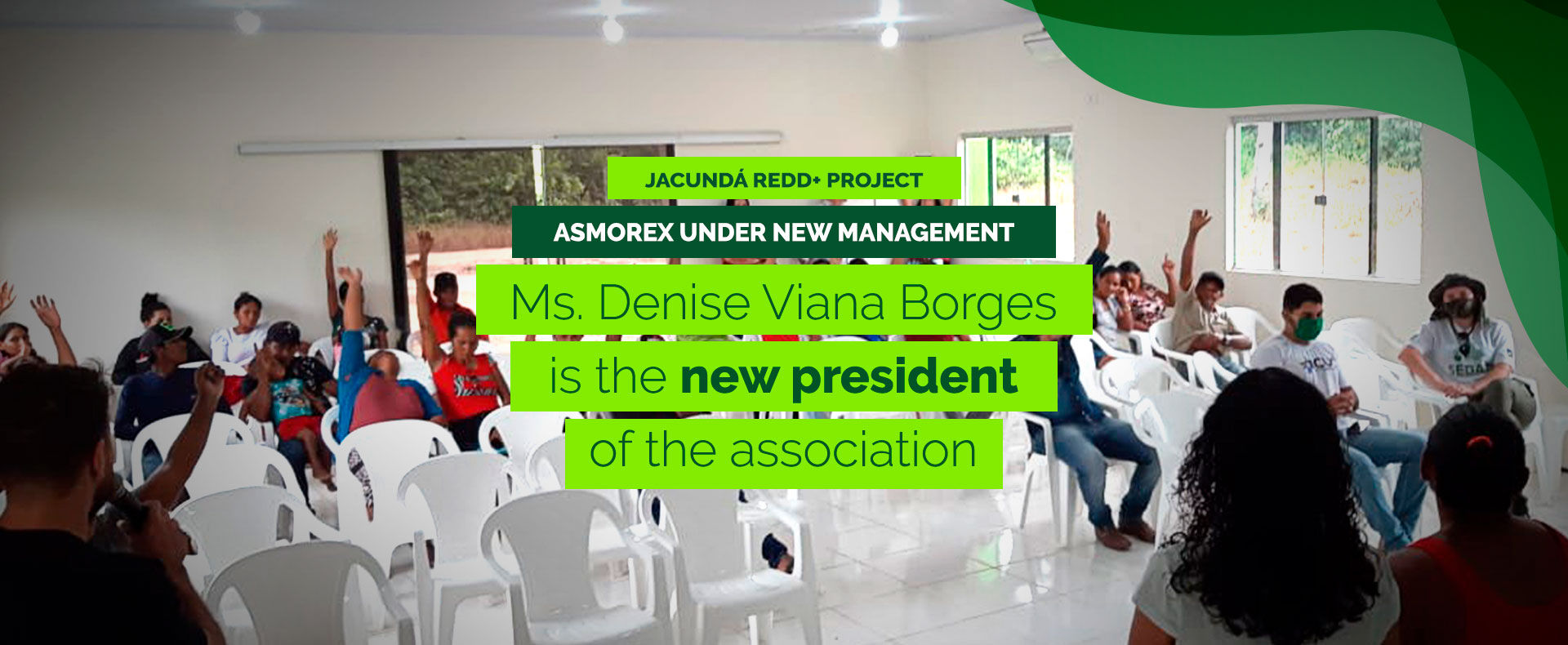
RESEX Jacundá REDD+: ASMOREX under new management: Ms. Denise Viana Borges is the new president of the association.

New female leadership reflects the growing participation of young people in the Rio Preto-Jacundá Extractive Reserve Residents’ Association (ASMOREX), representing an important step toward greater gender equality and community empowerment.

New ASMOREX management

In January, the Rio Preto-Jacundá Extractive Reserve Residents’ Association (ASMOREX) held an important community assembly. During the meeting, members approved the 2020 accountability report, the work plan that defines future investments and the association’s new management team.

As with all decisions made by the 30 families living in the region and participating in ASMOREX, the election of the new board was unanimous. The result reflects a moment of strong engagement, cooperation and unity among community members.

The previous management, led by José Pinheiro, was passed on to Denise Viana Borges, 25 years old, representing a new generation of residents who have actively participated in community activities, including serving as coordinator of the computer training course.


New ASMOREX management team

In addition to Denise Viana Borges as president, the new board is composed of:

  • Roseni Matos Dias – Vice President
  • Maria Rosalina de Oliveira Carril Borges – Treasurer
  • Jorgelino Mota Evangelista – Secretary
  • Renato Bona Marques – Chairman of the Fiscal Council
  • Mário Sérgio Pinheiro Borges – Fiscal Council Alternate
  • Lucirley Alves de Oliveira – Fiscal Council Alternate

When the Rio Preto-Jacundá REDD+ Project began in 2012 as an initiative focused on improving quality of life in the community, Denise was a teenager who watched her parents participate in the transformations promoted by the project. Today, she brings to the leadership the perspective of someone who grew up alongside these changes and wants to continue building new opportunities for the Reserve.

“Despite being a great responsibility for me and everyone involved in this management, I feel privileged not only for being the youngest president, but also for being a woman in a leadership position within our association. We have the opportunity to demonstrate our work and, together with our partners, achieve great victories and bring even more benefits to our community and organization.”

Denise Viana Borges, President of ASMOREX

Denise Viana Borges
President
ASMOREX


Since the beginning of the project’s activities, one of the commitments has been to involve, train, create opportunities for and give voice to young people and women from ASMOREX. In addition to representing progress toward gender equality, one of the United Nations Sustainable Development Goals, the new leadership demonstrates the growing participation of the community in decision-making processes.

UN Sustainable Development Goal 5 - Gender Equality


ASMOREX

The Rio Preto-Jacundá Extractive Reserve Residents’ Association (ASMOREX) is composed of 30 families living in the region and plays a central role in decision-making and defining improvement initiatives for the community.

These actions are supported by socio-environmental investments generated through the commercialization of REDD+ carbon credits with Brazilian and international buyers since 2012.

Children from the Rio Preto-Jacundá Extractive Reserve community


Rio Preto-Jacundá REDD+ Project

The Rio Preto-Jacundá Extractive Reserve is a Conservation Unit created in the 1990s for traditional rubber-producing populations.

The REDD+ Project focuses on improving community quality of life while supporting forest cover and biodiversity monitoring to reduce social and environmental impacts in the region.

RESEX Jacundá REDD+ Project


Would you like to learn more about the RESEX Jacundá REDD+ Project, which contributes to reducing deforestation, mitigating environmental impacts and supporting the sustainable development of the Extractive Reserve community?


Learn more about the RESEX Jacundá REDD+ Project