




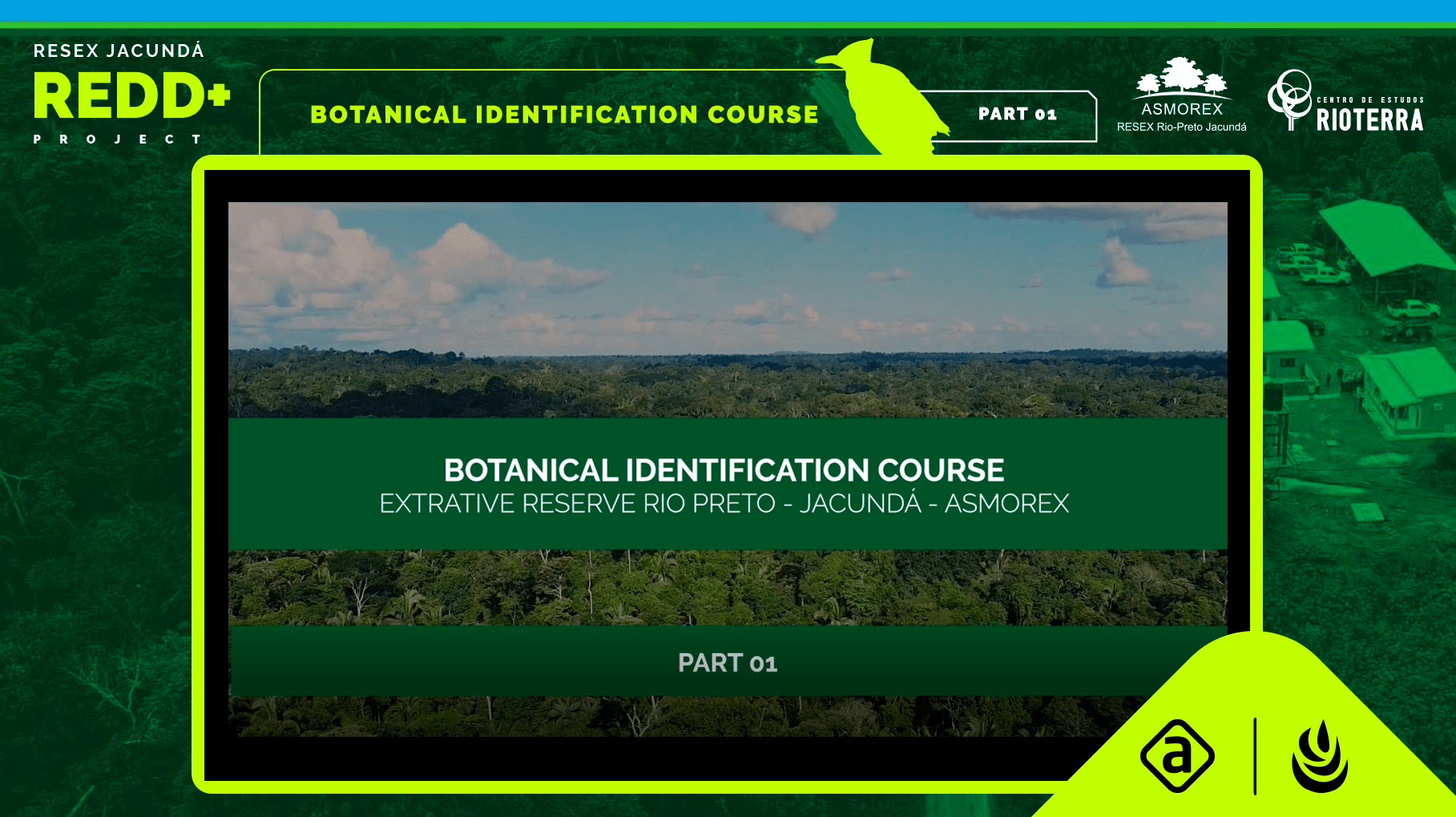
Reducing deforestation, protecting biodiversity and expanding access to education are key pillars of the Rio Preto-Jacundá REDD+ Project. Residents engaged in sustainable forest management received specialized training in botanical collection and species identification.
Continuous community engagement in forest conservation activities encourages residents to better understand the value of the Amazon and motivates them to improve the skills needed for sustainable forest management. Supporting education and technical training is therefore one of the core commitments of the Rio Preto-Jacundá REDD+ Project.
Based on needs identified by the residents themselves, the Botanical Identification Course was included in the project’s 2022 Activity Plan. The initiative was developed through a partnership between Biofílica, ASMOREX, CES Rioterra, UNIR (Federal University of Rondônia) and the New York Botanical Garden, providing practical training on the identification of native tree species through leaves, fruits and seeds.
“This week we are participating in the Botanical Collection and Identification Course, where we are learning about every part of a tree—its leaves, fruits and seeds. It has been a very promising activity, and we have learned a great deal.”
Denise Viana, President of ASMOREX
Beyond technical instruction, the course aims to strengthen local capacity so that community members can improve their livelihoods while contributing to scientific knowledge and sustainable forest management. Residents who live and work in the forest become essential partners in collecting botanical information, identifying species and supporting restoration and conservation initiatives.
“Without knowing the native plant species, it is impossible to manage forests or restore degraded areas. We need to train the people who live in the forest so they become our partners in identifying, collecting and understanding the local flora.”
Flávio Obermuller, Biologist at the New York Botanical Garden
Community empowerment supports conservation and sustainable development
The Rio Preto-Jacundá REDD+ Project recognizes that empowering local communities is fundamental to achieving long-term conservation outcomes. Educational initiatives such as this course directly contribute to two of the project’s primary objectives:
- Promote the reduction of deforestation, conserve standing forests and protect biodiversity while maintaining ecosystem services and preserving the traditional livelihoods of families living in the Extractive Reserve.
- Expand access to quality education and technical training, creating opportunities for better employment conditions, income diversification and sustainable economic development.
These initiatives contribute directly to the United Nations Sustainable Development Goals (SDGs 4 – Quality Education and 15 – Life on Land) while strengthening the social and environmental performance required to maintain the project’s CCBS Gold Level certification.
Watch the participants’ testimonials
Learn how the Botanical Identification Course is helping strengthen sustainable forest management and biodiversity conservation through the voices of the people directly involved.
Learn more about the Rio Preto-Jacundá REDD+ Project and discover how your organization can support forest conservation while offsetting carbon emissions with high-integrity carbon credits.
