
Rondônia uses REDD+ in its strategy to combat deforestation

Within the historically most-degraded Amazon regions, the state seeks to attract investments to enable sustainable productive actions with local communities and farmers.

Seeking solutions to deal with the climate crisis, to achieve the goals proposed in the Paris Agreement, and concerned about the lack of sufficient public resources to combat deforestation, the state of Rondônia saw in the Reduction of Emissions from Deforestation and Forest Degradation (REDD+) a practical strategy to generate revenue and conserve forests at the same time.


As explained in the article published by Página 22, a magazine that is a reference for sustainability topics in Brazil, Rondônia plans to follow a study prepared by Idesam to attract investments to generate resources through carbon markets. This is an approach based on growth that began before the crisis and that promises to grow again after the recovery, as analyzed by our CEO, Plínio Ribeiro.


“As a matter of available capital in the face of the Covid-19 emergency, the markets only paused, but they did not shut down the process that showed it was heating up in the six months preceding the current crisis, when there was a strong increase in demand for forest carbon credits.”

[one_third][/one_third]
[one_third]


Plínio Ribeiro
CEO of Biofílica, to Página 22


[/one_third]
[one_third][/one_third]


Rondônia currently has 75% of its remaining forests legally protected and the remaining 25% on private land. This means it is one of the most historically degraded regions of the Amazon. By keeping forests standing through means of REDD+ projects, the study underlining the strategy foresees that between 2016 and 2030 the emission of 156 million tons of carbon will be avoided and from the generated carbon credits, approximately US$ 780 million will be raised for the state.

The content also highlights the work of some projects, such as the REDD+ Rio Preto-Jacundá Project, a model initiative for the state of Rondônia that has already enabled local communities to earn revenues of R$ 3.5 million, reverted to their development, as a result of sustainable use of the forest and, consequently, of the carbon credits generated and sold by Biofílica to neutralize emissions from organizations in Brazil and the world.

Digital inclusion: project teaches computing to the RESEX community

Efforts to combat climate change cannot stop. Invest in neutralizing your company’s CO2 emissions through REDD+ Projects and contribute to curbing deforestation in the Amazon.


Be part of the change:
carbon credits are available to neutralize CO2 emissions!

Digital inclusion: project offers informatics training to RESEX community

A project developed by ASMOREX, in a partnership with Biofílica and Centro de Estudos Rioterra, aims to expand the professional qualification of the residents of the reserve.


The inhabitants of Reserva Extrativista Rio Preto-Jacundá, where Biofílica acts through a REDD+ Project in a partnership with Centro de Estudos Rioterra and Associação dos Moradores da RESEX (ASMOREX), are already attending free informatics courses held at the community complex telecenter.

Designed to reach students from all age groups, starting with children with 8 years who can read, the course arose from the association’s perception of  the importance of offering residents the opportunity to obtain the knowledge required to occupy administrative positions in the city or in the association itself.

“We need qualified people. For years,  ASMOREX has been managed by the same people due to lack of qualification; many here cannot even use a computer or use a keyboard to create a document”, explains
Denise Vieira Borges, coordinator of the course and activities.


In 4-hour weekly classes, the students have access to interactive videos and lessons ranging from introduction to informatics up to more complex software used in web development and creation, which are separated in basic and advanced modules.

“The course will add a lot to the curriculum of these people. Regardless of whether being here or in the city, it is essential to have an informatics course.” says Denise, who also notes: “Now they don’t have to go to the city or pay for attending a course. They take the course here, receive their certificate, and are able to use the knowledge acquired to work.”


ASMOREX Community Complex

The association’s community complex was inaugurated in April, 2019, and counts with eight houses, one community office with a computer room, cafeteria and auditorium, as well as a shed especially designed to house the machinery and equipment that facilitate the work routine of the extractivists who live in the area.

The facilities provided the community with new possibilities through internet access and electricity, which previously had a much smaller reach.

RESEX Jacundá REDD+ Project gains prominence in Verra’s website

Verra is internationally recognized for certifying carbon projects that generate measurable climate, social and biodiversity benefits.

Created in 2005, Verra is an internationally recognized organization specializing in the certification of greenhouse gas emissions reduction projects and the verification of environmental and social impacts generated by carbon initiatives. Its standards ensure that carbon credits purchased by companies represent real, measurable and independently verified emissions reductions.

Biofílica REDD+ Projects

To achieve this, Verra develops and manages some of the world’s leading standards for the voluntary carbon market. Among the most widely adopted are the Verified Carbon Standard (VCS), which certifies greenhouse gas emission reductions and enables the issuance of verified carbon credits, and the Climate, Community & Biodiversity Standards (CCBS), which assess projects based on their positive impacts on local communities and biodiversity conservation.

Verra certification standards

All REDD+ projects developed by Biofílica follow Verra’s methodologies and are certified under both the VCS and CCBS standards, ensuring high levels of environmental integrity, transparency and positive socio-environmental impact.

Among these initiatives, the Rio Preto-Jacundá REDD+ Project, developed in partnership with ASMOREX and the CES Rioterra, was featured on Verra’s official website. The project was recognized for demonstrating how REDD+ initiatives can combine forest conservation with improvements in the quality of life of traditional Amazon communities while strengthening biodiversity monitoring and sustainable development.


Learn more about the Rio Preto-Jacundá REDD+ Project on Verra’s official website.


Access the project page on the Verra Registry

Residents of RESEX Jacundá Extracting Reserve build community infrastructures

REDD+ Project enables new infrastructure that improves the quality of life for forest communities in the Rio Preto-Jacundá Extractive Reserve.

New community facilities at the Rio Preto-Jacundá Extractive Reserve

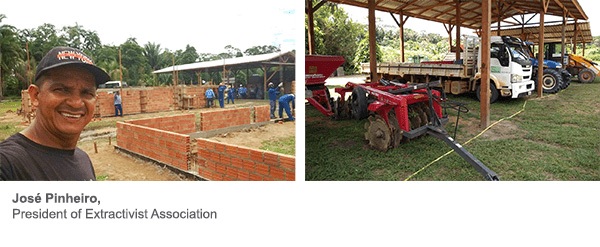
Nearly 30 families living in the Rio Preto-Jacundá Extractive Reserve (RESEX), a protected area covering 95,000 hectares in the municipalities of Machadinho D’Oeste and Cujubim, Rondônia, began benefiting from the construction of a new community complex. The works, launched in January 2019 and completed later that year, included eight new houses, a community office with an information technology room, a cafeteria, an auditorium and a dedicated facility for storing machinery and equipment used by local extractivist families.

The initiative was developed through a partnership between Biofílica, the Rio Preto-Jacundá Extractive Reserve Residents’ Association (ASMOREX), the CES Rioterra and the Government of the State of Rondônia. The investments were made possible through the commercialization of REDD+ carbon credits generated by the project, demonstrating how climate finance can simultaneously support forest conservation and strengthen local livelihoods.

Since 2012, the project has directed resources toward improving living conditions in the Reserve while protecting forests threatened by deforestation. Beyond environmental conservation, the initiative contributes to the socio-economic development of traditional communities that often face limited access to basic infrastructure and public services.


José Pinheiro Borges

“The structure we had before was improvised. Sometimes we could barely hold association meetings during the dry season because there wasn’t enough water even for the bathrooms.”

José Pinheiro Borges, President of ASMOREX


Infrastructure that creates new opportunities

Among the new facilities, the information technology room is expected to have one of the greatest impacts, especially for children and teenagers, who now have access to computers and the internet. The new infrastructure expands educational opportunities while strengthening communication within the community.

The project also brought renewable energy solutions to five riverside families living along the Rio Preto River through photovoltaic power generation systems. Previously, electricity depended on small fuel-powered generators that operated for only a few hours each day.

Reliable access to electricity has transformed everyday life by improving household comfort and creating new economic opportunities. With freezers operating continuously, families are now able to safely store highly perishable forest products, such as açaí, increasing their potential income and reducing losses during harvest periods.


Learn how the Rio Preto-Jacundá REDD+ Project combines forest conservation with investments that improve the quality of life of traditional Amazon communities.


Learn more about the Rio Preto-Jacundá REDD+ Project

RESEX Jacundá REDD+ Project – A Collective Path for Forest Conservation and Community Development

The Rio Preto Jacundá Extractive Reserve, located northeast of the state of Rondônia, is home to 130 traditional residents whose livelihoods are based on extractive activities and small-scale agriculture. Despite the natural wealth present in the forest, many community members live below the poverty line, depending on government assistance programs and facing challenges related to territorial security and sustainable development.

The REDD+ Jacundá Project is a collective initiative developed by the Association of Residents of the Reserve, the NGO Rioterra, the Secretariat of Environmental Development (SEDAM) of Rondônia, and Biofílica. The project aims to strengthen community autonomy in the management and economic development of the Reserve, enabling residents to become protagonists in decision-making processes and contribute directly to biodiversity conservation.

To achieve this goal, several workshops have been conducted through a long-term and cyclical process involving diagnosis, training, awareness raising, collective planning, and, in the current phase, implementation of the activities defined by the community.

Two important workshops were essential for reaching this stage: the definition of the community’s Life Plan and the construction of the Benefit Sharing and Conflict Resolution Mechanism of the REDD+ Project.


A Life Plan built by the community

The community’s Life Plan was developed based on an analysis of the local reality and the collective definition of beliefs, values, and principles. The initiative aims to guide the creation of a Work Plan aligned with the needs, priorities, and aspirations of the Reserve’s residents.

During the workshops, community members were encouraged to discuss and reflect on local socio-environmental, cultural, political, and economic challenges. This participatory process resulted in an Action Plan that represents the community’s main aspirations and priorities.

Among the key themes identified by residents are:

  • Recovery of traditional medicine practices and promotion of preventive healthcare;
  • Expansion of income generation opportunities;
  • Investments in education and technical training;
  • Improvement of housing conditions;
  • Greater inclusion and participation of young people;
  • Strengthening women’s participation;
  • Forest conservation and sustainable use of natural resources.

Participatory construction of the Benefit Sharing Mechanism

Another important milestone was the collective construction of the Benefit Sharing and Conflict Resolution Mechanism, designed to establish the foundation for a transparent and participatory process aligned with the community’s aspirations.

The mechanism seeks to ensure that the benefits generated by the project contribute effectively to strengthening the traditional extractive way of life while promoting social, environmental, cultural, and economic development within the Reserve.

The main pillars defined by the community for the creation of the Benefit Sharing Mechanism include:

  • Alignment with the demands and priorities of the Reserve;
  • Guarantee of social, ecological, cultural, and economic viability of the extractive way of life;
  • Promotion of gender empowerment and cultural strengthening;
  • Investments in infrastructure, communication, education, and income generation;
  • Collaborative management committed to community aspirations.

In addition, it was established that project governance will be strengthened through the experience and participation of partner institutions — Asmorex, Biofílica, CES Rioterra, SEDAM, and UNIR — through a Management Council that will meet periodically to guide and monitor project activities.


Social empowerment and forest conservation

These workshops were fundamental for the structuring of the REDD+ Jacundá Project and represent an example of how project management will be conducted in the coming years: through community participation, social empowerment, and collective decision-making.

By strengthening local governance and supporting sustainable development initiatives, the project seeks to improve the quality of life of traditional residents while reconciling socioeconomic development with forest conservation and biodiversity protection.

Resex Rio Preto Jacundá REDD+ Project Report of a local extractive community member

Protected areas have emerged as a solution to several environmental problems. Its origins are in the communities of rubber tappers who, during the 70s and 80s, assumed the role of forest guardians in the Amazon. We believe that the objective of the creation of a Protected Area was to guarantee the survival of traditional populations in their way of life based on collecting natural resources, besides occupying these areas to guarantee the protection of the Amazon Forest biodiversity.

The Rio Preto Jacundá Protected Area was created by the State Decree  7,336, dated January 17th, 1996, and declared the region as of ecological and social interest for the benefit and use of its native population, that is, the forest peoples, in the case, rubber tappers. It is a territorial space destined to self-sustaining exploitation and conservation of renewable natural resources. Today, after some legal modifications, it has a determined an area of 95,300 hectares, being located in the municipality of Machadinho D’Oeste, near the interstate border of Rondônia and Amazonas.

In 2001, the Resex Rio Preto Jacundá Residents’ Association (Asmorex) was founded, with the objective of providing legal representation to the Protected Area’s extractive population, in addition to enable engagement with public policies and projects that could benefit local residents. Even in the face of such possibilities, we face many difficulties in developing our activities, due to the lack of knowledge and qualification of our people in conducting the Association.

In September 2011, participating in a seminar in the city of Porto Velho, held by CES Rioterra, we envisioned the opportunity to implement the REDD+ project  with Biofílica, which is now a reality. It was more than five years of a joint battle between Asmorex, communities, Biofílica and CES Rioterra in the elaboration of a promising project, which we are currently looking at with optimism, through its positive results.

The current reality, despite a horizon of possibilities through the REDD+ Project, is also challenging, since we are facing strong pressure from invaders who try at any cost to get hold of the area, causing fear to the inhabitants of origin of the Area. In any case, although State enforcement authorities are fulfilling their role, this work has been insufficient in recent years, reflecting a considerable increase in recent deforestation.

Another challenge is to rescue and maintain the cultural identity of our people, due to the current innovative context, interpersonal relationships with surrounding migrant populations, and even accessible urban centers, which has strongly influenced the customs and traditions of our extractive communities.

I see the REDD+ project of Resex Rio Preto Jacundá as an opportunity to foster the Area in its social, cultural, ecological and economic scope, in addition to being a territorial protection strategy in partnership with the State of Rondônia. I believe in God and in the REDD+ project of Rio Preto Jacundá, that our goals will be achieved and at the same time we will be grateful and proud of our work and our partners, who have placed in us their confidence in the construction of an arduous but praiseworthy common good strategy, the reconciliation of Man and Nature.

José Pinheiro Borges

Community extractive resident at Resex Rio Preto Jacundá